Monopoly
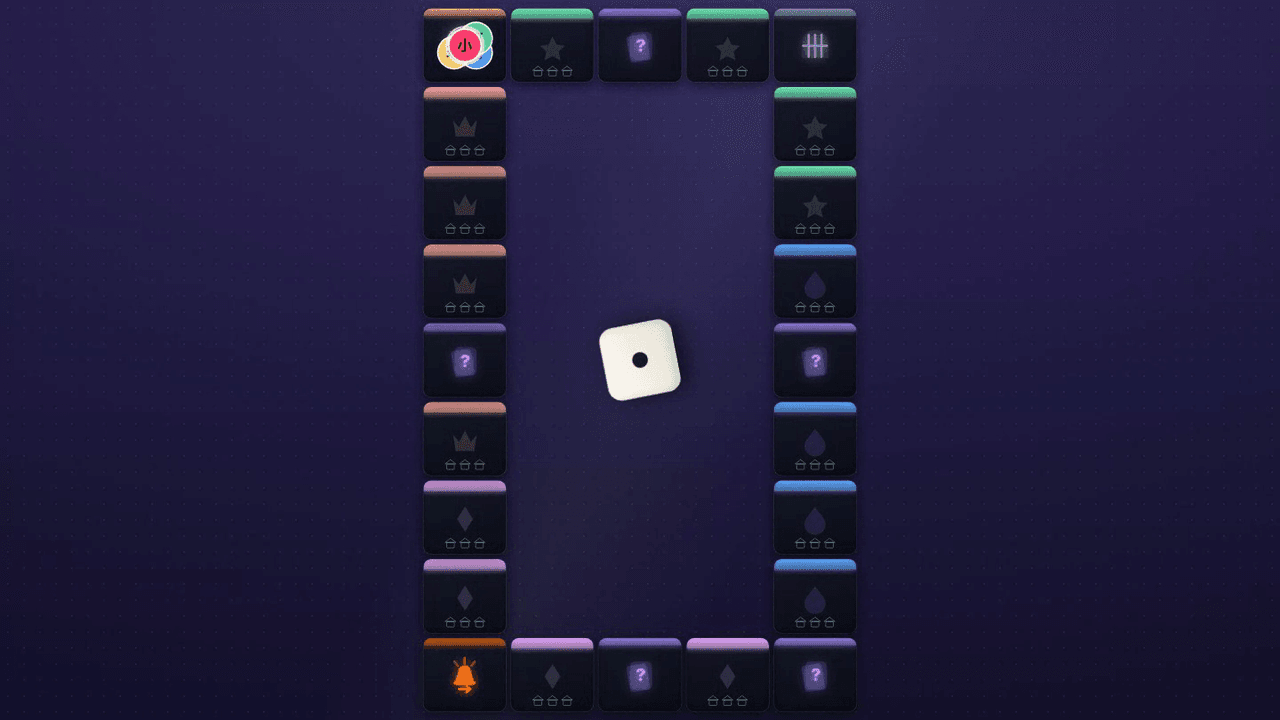
"Monopoly" is a multi-host scoring game: 2–8 hosts each take a seat and roll the dice in turn around a ring-shaped board. Land on an empty tile and viewers gift to fund the purchase for that host; land on a tile you already own and viewers can fund an upgrade instead; land on someone else's tile and you trigger the penalty wheel for a mini punishment; land on someone else's fully-upgraded landmark and you go straight to jail. The game never picks a winner — wrap-up shows a fun stats board instead.
This game has no winner
Unlike other scoring games, Monopoly has no score ranking. When you wrap up, the stats board hands out fun, sometimes-unflattering badges like "Most time in jail," "Most penalties," and "Property tycoon" — every seat gets one, and nobody loses.
What viewers see
The board is a 24-tile ring (a 5×9 rectangle). The middle is completely transparent — that's deliberate: the overlay can't touch the video underneath, so a hollow ring is what lets every host's face show through the center while the board only draws on the outer loop. Each seat has its own token color; tokens sharing a tile nudge apart slightly so they don't stack invisibly.
When it's a seat's turn to roll, the center of the board plays a dice-tumbling animation, then the token walks step by step to the landing tile. A result card pops up in the middle for a few seconds, then the board goes fully transparent again. Depending on where you land, viewers next see one of:
- An empty tile — a funding window pops up showing "raised X / Y diamonds" plus a countdown; gifts from that host's fans push the bar forward.
- Your own tile (not maxed out) — same funding window, but it's raising money for an upgrade this time.
- Someone else's tile, level 1–3 — the screen switches to a penalty wheel; the host acts out whatever it lands on.
- Someone else's maxed-out landmark, or the "Go to Jail" tile — straight to a jail animation.
- A Chance tile — a flip animation reveals one of three outcomes: free upgrade, straight to jail, or roll again.
Funding that falls short still keeps the diamonds
If a funding window's countdown ends before the target is reached, the deal falls through and the tile stays unowned — someone can land there and fund it later. But every diamond sent during that window still counts on the gift leaderboard and the full session report; nothing is lost just because the deal fell through.
Set it up before you go live
Pick 'Monopoly'
Go to the "Scoring Games" page and pick "Monopoly" in step 1.
Pick the seats in play
In the workbench, check the 2–8 seats joining this game. Names come from the Hosts list; unset seats just show a letter (A/B/C…). You need at least 2 to start.
Set the three main parameters
Base land price (diamonds) — the four zones on the board multiply this automatically, so later zones cost more; Funding countdown (seconds) — how long the funding window stays open when someone lands on an empty tile or wants to upgrade, tune it to how lively the room is; Jail bail (diamonds) — the ransom to get out of jail early, set separately from the base land price since they mean different things.

(Optional) Open 'Advanced'
You rarely need this — expand it only when you want finer control over pacing. Zone price multipliers (raise the last zone to widen the price spread across the board); Upgrade thresholds (the multiplier for building level 1→2, 2→3, and 3→4, applied to that tile's own sale price, not the base price); Penalty wheels by level (which existing wheel content loads when someone lands on a rival's level 1/2/3 tile); Animation speed (how long the dice roll and each step takes — visual pacing only, never changes the number rolled). Changes here only affect future turns — they never rewrite deeds already bought or funding already in progress.
Save to Home
Hit "Save to Home" at the bottom of the page — the config is stored and shows up on Home automatically, ready to run once you're live.
Running it live
Back on Home, find the "Monopoly" card you saved:
Hit "Start Monopoly" to open the game — the first seat's turn lights up "Roll dice." Tap it and the dice-roll animation plays; once the token finishes walking, the screen automatically switches to whatever the landing tile calls for (funding window / penalty wheel / an already-resolved Chance card outcome). Dice and turn order pause while a tile is being resolved, and only resume once it's settled.
Once the current tile is resolved, hit "Next player" to hand off. If that seat passed GO along the way, it gets one free extra roll — the panel flags it, and hitting "Next player" without using it gives it up. Tap "Pause" mid-game if you need a break — the countdown freezes with it — and "Resume" to pick back up; a long pause won't cause it to auto-close the moment you come back.
Getting out of jail
A seat in jail is automatically skipped on its turn. If nobody pays the bail, it's freed automatically after serving one full lap (every other seat rolling once). Bail is a separate number from the base land price — changing one never moves the other.
When you want to end the game, hit "Call it and wrap up" — there's a confirmation step (any funding window still open fails, though its diamonds still count on the gift leaderboard). Wrapping up puts a fun stats board on the overlay: who spent the most time in jail, who got penalized the most, the priciest plot on the board, and the biggest sponsor overall, each with a name attached; every other seat gets a fallback badge like "Globetrotter" or "Smooth sailing." The same stats land in the session report. After wrapping up, "Reset" changes meaning — it clears the board for a brand-new game.
Common questions
Q: Does Monopoly have a winner or a ranking? A: No. This game deliberately skips scoring a winner — wrapping up shows a fun stats board where every seat gets a badge (Most time in jail / Most penalties / Property tycoon / Fan power / Globetrotter / Smooth sailing), with no ranking involved.
Q: What happens if a funding window falls short? A: The tile stays unowned (the deal falls through) and someone else can land there and fund it later — but the diamonds sent during that countdown still count on the gift leaderboard and the session report; nothing disappears.
Q: Does landing on a rival's tile always trigger a penalty? A: Levels 1–3 trigger the penalty wheel and the host acts out whatever it lands on. A rival's fully-upgraded landmark skips the wheel entirely and sends you straight to jail instead.
Q: Is jail bail the same number as the base land price? A: No, they're two separate settings. Even if nobody pays bail, serving one full lap (every other seat rolling once) frees the seat automatically.
Q: What can a Chance card give you? A: One of three outcomes: a free upgrade on the tile you're standing on (less common), straight to jail, or an extra roll. If you draw the free upgrade but don't own anything left to build on, it simply has no effect.
Q: Do hosts need to keep tuning the pacing? A: Not usually — the three main parameters cover nine out of ten sessions. Only open "Advanced" to tighten or loosen the pacing for a longer show; changes there only affect turns from that point on.